Basic Example
Basic Example
Patients arrive at a hospital emergency department, where they are assessed through a triage system and then directed to the appropriate hospital units. The conceptual model is presented* below.
*DESK adopts BPMN (.bpmn) as an open, tool-independent notation for representing activity-cycle and process-interaction models. Although BPMN is not a simulation-native language, its standardized semantics and widespread support make it a suitable representation for discrete-event simulation models.
Models in .bpmn format can be created and shared using the
BPMN Web Modeler (bpmn.io).
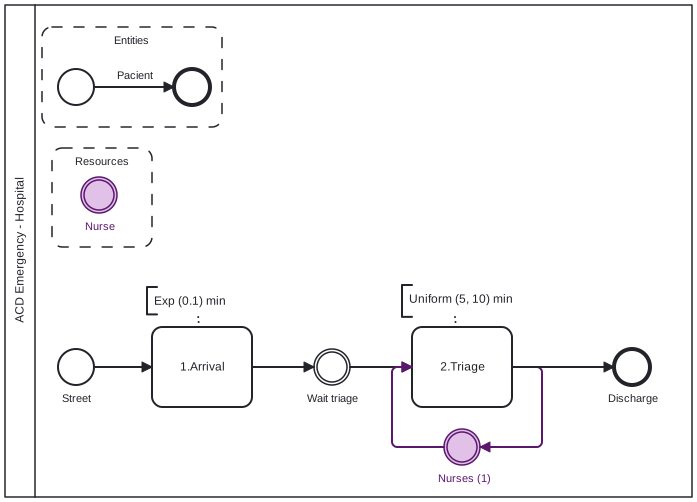 

Create a basic.py file and Copy/Paste the Part1 code below.
Following, run: desk-sim -m basic.py --mode single
# ==============================================================
# Part 1: Basic simulation model: Nurses on emergency triage (hospital)
# ==============================================================

def build_model(until=None, event_logger=None, verbose=True):

    import random
    from desk.core.simulation_model import SimulationModel
    from desk.core.entity import EventLogger
    from desk.blocks.create_block import CreateBlock
    from desk.blocks.process_block import ProcessBlock
    from desk.blocks.dispose_block import DisposeBlock

    # Create model
    model = SimulationModel(verbose=verbose)

    # Add resources
    nurses = model.add_resource("Nurses", capacity=3)

    # Define blocks
    arrivals = CreateBlock(
        "Arrivals", model.env,
        inter_arrival_time=lambda: random.expovariate(1/10),
        entity_prefix="Patient",
        event_logger=event_logger
    )

    triage = ProcessBlock(
        "Triage", model.env,
        resource=nurses,
        delay_time=lambda: random.uniform(5, 10),
        resource_units=1,
        event_logger=event_logger
    )

    discharge = DisposeBlock("Discharge", model.env, event_logger=event_logger)

    # Register blocks
    for block in [arrivals, triage, discharge]:
        model.add_block(block)

    # Connect flow
    arrivals.connect_to(triage)
    triage.connect_to(discharge)

    return model


# Run a simulation replication
def main():
    from desk.core.entity import EventLogger

    HOURS = 60  # Time conversion factor (base time: minutes)
    DAYS = 1440
    YEARS = 525600

    # Create event logger
    event_logger = EventLogger()

    model = build_model(event_logger=event_logger, verbose=False)

    model.run_simulation(
        until=8*HOURS,          # 8 hours
        warm_up_period=1*HOURS,  # 1 hour
        seed=123
    )

    # Report results
    from desk.analytics.reporting import SimulationReporter
    reporter = SimulationReporter(model)
    reporter.print_results()
    reporter._print_activity_metrics()
    reporter._print_resource_metrics()
    reporter._print_entity_counts()
    reporter._print_block_statistics()

    return model, event_logger

# ===========================================
# Simulation Kit
# ===========================================

# Run a simulation replication
def run_single_replication():
    return main()

# Run a full simulation
def run_replications_cli():
    run_replications()

# Run a factorial analysis
def run_factorial_cli():
    return factorial_analysis()

# Run the simulation with interface
def run_visualization_cli(simulation_time=500):
    return run_visualization(build_model, simulation_time=simulation_time)
📊 Simulation Analysis (Replications)
Now, Copy/Paste the Part2 code below and add to the basic.py file.
Following, run: desk-sim -m basic.py --mode replications
# ... (after) "return model, event_logger"...
# ==============================================================
# Part 2: Additional code: Full simulation (replications framework)
# ==============================================================

# Define simulation function wrapper
def simulation_wrapper(seed=None, until=None, warm_up_period=None):
    """Wrapper function for replication framework."""

    from desk.core.entity import EventLogger
    event_logger = EventLogger()

    # Create a fresh model
    model = build_model(until=until, event_logger=event_logger, verbose=False)

    model.run_simulation(
        validate_resources=False,
        until=until,
        seed=seed,
        warm_up_period=warm_up_period
    )

    return model

def run_replications():
    from desk.stats.replication import ReplicationFramework

    replication_framework = ReplicationFramework(
        simulation_function=simulation_wrapper,
        n_replications=30
    )

    HOURS = 60  # Time conversion factor (base time: minutes)
    DAYS = 1440
    YEARS = 525600

    replication_framework.run_replications(
        base_seed=12345,
        until=8*HOURS,
        warm_up_period=1*HOURS
    )

    # Access results
    df = replication_framework.get_results_dataframe()
    print(df.describe())

# ... keep the original (Simulation Kit) code
# ===========================================
# Simulation Kit
# ===========================================
🧪 Experimental Design (Factorial)
Now, Copy/Paste the Part3 code below and add to the basic.py file.
Following, run: desk-sim -m basic.py --mode factorial
# ... after "print(df.describe())"...
# ==============================================================
# Part 3: Additional code: Factorial experiment
# ==============================================================
def factorial_analysis():
    """Factorial analysis with simulation."""

    from desk.stats.factorial import FactorialExperiment

    HOURS = 60  # Time conversion factor (base time: minutes)
    DAYS = 1440
    YEARS = 525600


    def simulation_wrapper(arrival_rate=1, num_nurses=1,
                                seed=None, until=None, warm_up_period=0, **kwargs):
        """Wrapper that adapts parameters for factorial analysis."""

        from desk.core.entity import EventLogger
        event_logger = EventLogger()

        # Create a fresh model
        model = build_model(until=until, event_logger=event_logger, verbose=False)

        model.run_simulation(
            validate_resources=False,
            until=until,
            seed=seed,
            warm_up_period=warm_up_period
        )

        return model

    # Create factorial analysis
    factorial = FactorialExperiment(
        simulation_function=simulation_wrapper,
        base_seed=12345
    )

    # Add factors
    factorial.add_factor(
        factor_name='arrival_rate',
        parameter_path='CreateBlock.inter_arrival_time',
        levels=[1, 2, 3],  # Minutes between arrivals
        description='Inter arrival rates (min)'
    )

    factorial.add_factor(
        factor_name='num_nurses',
        parameter_path='Resource.nurses.capacity',
        levels=[1, 2, 3],
        description='Number of nurses'
    )

    # Run experiment
    factorial.run_factorial_experiment(
        n_replications=5,
        simulation_time=4*HOURS,  # 4 hours
        warm_up_period=1/2*HOURS,    # 1/2 hour
        verbose=True
    )

    # Analyze results
    factorial.print_summary()
    factorial.plot_correlation_matrix()
    factorial.plot_main_effects('system_time_avg')
    factorial.plot_interaction_effects('system_time_avg', 'arrival_rate', 'num_nurses')

    return factorial

# ... keep the original (Simulation Kit) code
# ===========================================
# Simulation Kit
# ===========================================
🔁 Run Interface (Visualization)
Finally, Copy/Paste the Part4 code below and add to the basic.py file.
Following, run: desk-sim -m basic.py --mode visualization
Actually, this can be the first part in a simulation study.
# ... after "return factorial"...
# ==============================================================
# Part 4: Additional code: Interface - visualization
# ==============================================================
from desk.visualization.interface import run_visualization

# ... keep the original (Simulation Kit) code
# ===========================================
# Simulation Kit
# ===========================================